
Dynamic content with metaobjects in Hydrogen

This recipe creates a content management system using Shopify metaobjects. It lets you create and manage dynamic content sections through your Shopify admin, providing a flexible way to build pages with reusable components.

Key features:

  • Dynamic route-based content rendering
  • Modular section components (Hero, Featured Products, Featured Collections, Stores)
  • Content editing capabilities with direct links to Shopify admin
  • Rich text support with Slate editor
  • Comprehensive documentation with visual guides

This recipe includes example section components that can be customized or extended to match your specific content needs. See the included guides/metaobjects/README.md file for detailed setup instructions.

Note

You need to create the metaobject definitions in your Shopify admin before using this recipe. Each section component has a one-to-one relationship with a metaobject definition.


  • Basic understanding of Shopify metaobjects
  • Shopify store with metaobjects enabled (Shopify Plus or development store)
  • Metaobject definitions created in your Shopify admin
  • Environment variable: PUBLIC_STORE_DOMAIN (your store's admin domain)

New files added to the template by this recipe.


Anchor to Step 1: Document the metaobjects CMSStep 1: Document the metaobjects CMS

Update the README file with metaobjects CMS documentation and an architecture overview.

File

@@ -1,6 +1,8 @@
-# Hydrogen template: Skeleton
+# Hydrogen template: Metaobjects as CMS
-Hydrogen is Shopify’s stack for headless commerce. Hydrogen is designed to dovetail with [Remix](https://remix.run/), Shopify’s full stack web framework. This template contains a **minimal setup** of components, queries and tooling to get started with Hydrogen.
+This Hydrogen template demonstrates how to use Shopify Metaobjects as a content management system (CMS). Hydrogen is Shopify's stack for headless commerce, designed to work with [Remix](https://remix.run/), Shopify's full stack web framework.
+
+This template shows how to create a flexible, section-based content architecture using Shopify's native Metaobjects, allowing merchants to manage content directly from the Shopify admin without external CMS dependencies.
[Check out Hydrogen docs](https://shopify.dev/custom-storefronts/hydrogen)
[Get familiar with Remix](https://remix.run/docs/en/v1)
@@ -16,18 +18,60 @@ Hydrogen is Shopify’s stack for headless commerce. Hydrogen is designed to dov
- Prettier
- GraphQL generator
- TypeScript and JavaScript flavors
-- Minimal setup of components and routes
+- **Metaobjects-based CMS architecture**
+- **Dynamic section rendering system**
+- **Content management through Shopify admin**
+
+## Metaobjects Architecture
+
+This template implements a hierarchical content structure:
+
+```
+Route (Metaobject)
+ └── Sections (References)
+ ├── SectionHero
+ ├── SectionFeaturedProducts
+ ├── SectionFeaturedCollections
+ ├── SectionStoreProfile
+ └── SectionStoreGrid
+```
+
+### Key Features
+
+- **Route-based content**: Each route can have its own set of sections
+- **Reusable sections**: Create once, use across multiple routes
+- **Type-safe**: Full TypeScript support with generated types
+- **Merchant-friendly**: Content managed directly in Shopify admin
+- **Extensible**: Easy to add new section types
## Getting started
**Requirements:**
- Node.js version 18.0.0 or higher
+- Shopify store with Metaobjects enabled
+- Metaobject definitions created in Shopify admin
```bash
npm create @shopify/hydrogen@latest
```
+## Setting up Metaobjects
+
+1. **Create Metaobject definitions** in your Shopify admin:
+ - Navigate to Settings → Custom data → Metaobjects
+ - Create definitions for Route, SectionHero, SectionFeaturedProducts, etc.
+ - See `guides/metaobjects/README.md` for detailed field configurations
+
+2. **Create content entries**:
+ - Add Route entries for pages you want to manage
+ - Create Section entries and link them to Routes
+ - Configure section content and references
+
+3. **Query and render**:
+ - Routes automatically query their associated sections
+ - Sections component handles dynamic rendering based on type
+
## Building for production
```bash
@@ -40,6 +84,21 @@ npm run build
npm run dev
```
+## Creating New Sections
+
+1. Define the Metaobject in Shopify admin
+2. Create a React component in `app/sections/`
+3. Add the GraphQL fragment for querying
+4. Register in the Sections component switch statement
+
+Example:
+```tsx
+export function SectionExample(props: SectionExampleFragment) {
+ const section = parseSection<...>(props);
+ return <section>...</section>;
+}
+```
+
## Setup for using Customer Account API (`/account` section)
-Follow step 1 and 2 of <https://shopify.dev/docs/custom-storefronts/building-with-the-customer-account-api/hydrogen#step-1-set-up-a-public-domain-for-local-development>
+Follow step 1 and 2 of <https://shopify.dev/docs/custom-storefronts/building-with-the-customer-account-api/hydrogen#step-1-set-up-a-public-domain-for-local-development>
\ No newline at end of file

Anchor to Step 2: Add product fragment for sectionsStep 2: Add product fragment for sections

Add RECOMMENDED_PRODUCT_FRAGMENT for displaying product collections in metaobject sections.

@@ -232,3 +232,25 @@ export const FOOTER_QUERY = `#graphql
}
${MENU_FRAGMENT}
` as const;
+
+// @description Fragment for recommended products needed by ProductItem component
+export const RECOMMENDED_PRODUCT_FRAGMENT = `#graphql
+ fragment RecommendedProduct on Product {
+ id
+ title
+ handle
+ priceRange {
+ minVariantPrice {
+ amount
+ currencyCode
+ }
+ }
+ featuredImage {
+ id
+ url
+ altText
+ width
+ height
+ }
+ }
+` as const;

Anchor to Step 3: Create edit route componentStep 3: Create edit route component

Add the edit route component for managing metaobject-based content in development.

File

import {useState, useEffect} from 'react';
import {Link, useMatches} from 'react-router';

/**
* Displays an `Edit Route` button in the top right corner of the page
* This button opens a new tab that let's you easily edit the metaobject entry in the Shopify Admin
* This is only display when in development or when in preview branch deployment
*/
export function EditRoute({routeId}: {routeId: string}) {
const [url, setUrl] = useState<URL | null>(null);
const [root] = useMatches();
// @ts-expect-error data might not have publicStoreSubdomain
const publicStoreSubdomain = root?.data?.publicStoreSubdomain;

useEffect(() => {
setUrl(new URL(window.location.href));
}, []);

if (!url || !publicStoreSubdomain) return null;

const isDev =
url.hostname.includes('localhost') || url.hostname.includes('127.0.0.1');
const isPreview = url.hostname.includes('preview');
const legacyId = routeId.split('/').pop();
const adminEditUrl = `https://admin.shopify.com/store/${publicStoreSubdomain}/content/entries/route/${legacyId}`;

const shouldShowEditLink = isDev || isPreview;
if (!shouldShowEditLink) return null;

return (
<Link
to={adminEditUrl}
target="_blank"
rel="noreferrer"
style={{
position: 'absolute',
top: '5rem',
right: '3rem',
padding: '0.5rem',
backgroundColor: 'black',
color: 'white',
zIndex: 100,
}}
>
Edit Route
</Link>
);
}

Anchor to Step 4: Expose store subdomainStep 4: Expose store subdomain

Expose the public store subdomain for metaobject queries and content management.

@@ -90,6 +90,8 @@ export async function loader(args: Route.LoaderArgs) {
country: args.context.storefront.i18n.country,
language: args.context.storefront.i18n.language,
},
+ // @description Add public store subdomain for metaobjects
+ publictoreSubdomain: args.context.env.PUBLIC_STORE_DOMAIN,
};
}

Anchor to Step 5: Build store profile routeStep 5: Build store profile route

Add a dynamic store profile route for displaying store-specific metaobject content.

File

import {useLoaderData} from 'react-router';
import type {Route} from './+types/stores.$name';

// 1. Add metaobject content imports
import {ROUTE_CONTENT_QUERY, RouteContent} from '~/sections/RouteContent';

export const meta: Route.MetaFunction = () => {
return [{title: 'Hydrogen | Home'}];
};

export async function loader(args: Route.LoaderArgs) {
// Start fetching non-critical data without blocking time to first byte
const deferredData = loadDeferredData(args);

// Await the critical data required to render initial state of the page
const criticalData = await loadCriticalData(args);

return {...deferredData, ...criticalData};
}

/**
* Load data necessary for rendering content above the fold. This is the critical data
* needed to render the page. If it's unavailable, the whole page should 400 or 500 error.
*/
async function loadCriticalData({context, params}: Route.LoaderArgs) {
const {storefront} = context;
const {name} = params;
// 2. Query for the route's content metaobject
const [{route}] = await Promise.all([
storefront.query(ROUTE_CONTENT_QUERY, {
variables: {handle: `route-${name}`},
}),
// Add other queries here, so that they are loaded in parallel
]);

return {route};
}

/**
* Load data for rendering content below the fold. This data is deferred and will be
* fetched after the initial page load. If it's unavailable, the page should still 200.
* Make sure to not throw any errors here, as it will cause the page to 500.
*/
function loadDeferredData({context}: Route.LoaderArgs) {
// No deferred data for this route
return {};
}

export default function Store() {
const {route} = useLoaderData<typeof loader>();
return (
<div className="store">
{/* 3. Render the route's content sections */}
<RouteContent route={route} />
</div>
);
}

Anchor to Step 6: Add metaobjects to homepageStep 6: Add metaobjects to homepage

Integrate the RouteContent component to render metaobject sections on the homepage.

File

@@ -1,19 +1,11 @@
-import {
- Await,
- useLoaderData,
- Link,
-} from 'react-router';
+import {useLoaderData} from 'react-router';
import type {Route} from './+types/_index';
-import {Suspense} from 'react';
-import {Image} from '@shopify/hydrogen';
-import type {
- FeaturedCollectionFragment,
- RecommendedProductsQuery,
-} from 'storefrontapi.generated';
-import {ProductItem} from '~/components/ProductItem';
+
+// @description Add metaobject content imports
+import {ROUTE_CONTENT_QUERY, RouteContent} from '~/sections/RouteContent';
export const meta: Route.MetaFunction = () => {
- return [{title: 'Hydrogen | Home'}];
+ return [{title: 'Hydrogen Metaobject | Home'}];
};
export async function loader(args: Route.LoaderArgs) {
@@ -31,14 +23,18 @@ export async function loader(args: Route.LoaderArgs) {
* needed to render the page. If it's unavailable, the whole page should 400 or 500 error.
*/
async function loadCriticalData({context}: Route.LoaderArgs) {
- const [{collections}] = await Promise.all([
- context.storefront.query(FEATURED_COLLECTION_QUERY),
+ const {storefront} = context;
+
+ // @description Query the home route metaobject
+ const [{route}] = await Promise.all([
+ storefront.query(ROUTE_CONTENT_QUERY, {

Anchor to Step 7: Display all storesStep 7: Display all stores

Add a store listing page that shows all stores from metaobjects with a grid layout.

File

import {useLoaderData} from 'react-router';
import type {Route} from './+types/stores._index';

// 1. Add metaobject content imports
import {ROUTE_CONTENT_QUERY, RouteContent} from '~/sections/RouteContent';

export const meta: Route.MetaFunction = () => {
return [{title: 'Hydrogen | Home'}];
};

export async function loader(args: Route.LoaderArgs) {
// Start fetching non-critical data without blocking time to first byte
const deferredData = loadDeferredData(args);

// Await the critical data required to render initial state of the page
const criticalData = await loadCriticalData(args);

return {...deferredData, ...criticalData};
}

/**
* Load data necessary for rendering content above the fold. This is the critical data
* needed to render the page. If it's unavailable, the whole page should 400 or 500 error.
*/
async function loadCriticalData({context}: Route.LoaderArgs) {
const {storefront} = context;

// 2. Query for the route's content metaobject
const [{route}] = await Promise.all([
storefront.query(ROUTE_CONTENT_QUERY, {
variables: {handle: 'route-stores'},
cache: storefront.CacheNone(),
}),
// Add other queries here, so that they are loaded in parallel
]);

return {route};
}

/**
* Load data for rendering content below the fold. This data is deferred and will be
* fetched after the initial page load. If it's unavailable, the page should still 200.
* Make sure to not throw any errors here, as it will cause the page to 500.
*/
function loadDeferredData({context}: Route.LoaderArgs) {
// No deferred data for this route
return {};
}

export default function Stores() {
const {route} = useLoaderData<typeof loader>();

return (
<div className="stores">
{/* 3. Render the route's content sections */}
<RouteContent route={route} />
</div>
);
}

Anchor to Step 8: Install rich text dependenciesStep 8: Install rich text dependencies

Add Slate dependencies for rich text editing in metaobject sections.

@@ -21,7 +21,9 @@
"react": "18.3.1",
"react-dom": "18.3.1",
"react-router": "7.9.2",
- "react-router-dom": "7.9.2"
+ "react-router-dom": "7.9.2",
+ "slate": "^0.101.4",
+ "slate-react": "^0.101.3"
},
"devDependencies": {
"@eslint/compat": "^1.2.5",

Anchor to Step 9: Create route content componentStep 9: Create route content component

Add the main component for fetching and rendering metaobject-based route content.

File

import {SECTIONS_FRAGMENT, Sections} from '~/sections/Sections';
import {EditRoute} from '~/components/EditRoute';

import type {RouteContentQuery} from 'storefrontapi.generated';

export function RouteContent({route}: {route: RouteContentQuery['route']}) {
if (!route?.sections) {
return <p>No route content sections</p>;
}

return (
<div>
{route?.id && <EditRoute routeId={route.id} />}
{route?.sections && <Sections sections={route.sections} />}
</div>
);
}

export const ROUTE_CONTENT_QUERY = `#graphql
query RouteContent($handle: String!) {
route: metaobject(handle: {type: "route", handle: $handle}) {
type
id
title: field(key: "title") {
key
value
}
sections: field(key: "sections") {
...Sections
}
}
}
${SECTIONS_FRAGMENT}
`;

Add a section component for displaying featured product collections from metaobjects.

File

import type {
SectionFeaturedCollectionsFragment,
FeaturedCollectionImageFragment,
} from 'storefrontapi.generated';
import {parseSection} from '~/utils/parseSection';
import type {ParsedMetafields} from '@shopify/hydrogen';
import {Image} from '@shopify/hydrogen';

export function SectionFeaturedCollections(
props: SectionFeaturedCollectionsFragment,
) {
const section = parseSection<
SectionFeaturedCollectionsFragment,
{
heading?: ParsedMetafields['single_line_text_field'];
}
>(props);

const {id, heading, collections} = section;
return (
<section className="featured-collection" key={id}>
{heading && <h2>{heading.parsedValue}</h2>}
{collections?.nodes && (
<ul className="recommended-products-grid">
{collections.nodes.map((collection) => (
<li key={collection.id}>
<a href={`/collections/${collection.handle}`}>
<Image
style={{height: 'auto', width: 400}}
aspectRatio="1/1"
data={collection.image as FeaturedCollectionImageFragment}
/>
<h5>{collection.title}</h5>
</a>
</li>
))}
</ul>
)}
</section>
);
}

const FEATURED_COLLECTION_FRAGMENT = `#graphql
fragment FeaturedCollectionImage on Image {
altText
width
height
url
}

fragment FeaturedCollection on Collection {
id
title
handle
image {
...FeaturedCollectionImage
}
}
`;

export const SECTION_FEATURED_COLLECTIONS_FRAGMENT = `#graphql
fragment SectionFeaturedCollectionsField on MetaobjectField {
type
key
value
}
fragment SectionFeaturedCollections on Metaobject {
type
id
heading: field(key: "heading") {
...SectionFeaturedCollectionsField
}
collections: field(key: "collections") {
references(first: 10) {
nodes {
... on Collection {
...FeaturedCollection
}
}
}
}
withCollectionTitles: field(key: "with_collection_titles") {
...SectionFeaturedCollectionsField
}
}
${FEATURED_COLLECTION_FRAGMENT}
`;

Add a section component for showcasing featured products with a customizable layout.

File

import {Money, Image} from '@shopify/hydrogen';
import {Link} from 'react-router';
import type {SectionFeaturedProductsFragment} from 'storefrontapi.generated';

export function SectionFeaturedProducts(
props: SectionFeaturedProductsFragment,
) {
const {heading, body, products, withProductPrices} = props;
return (
<section>
{heading && <h2>{heading.value}</h2>}
{body && <p>{body.value}</p>}
{products?.references?.nodes && (
<div
style={{
display: 'grid',
gridTemplateColumns: '1fr 1fr 1fr',
gridGap: '1rem',
paddingTop: '1rem',
}}
>
{products.references.nodes.map((product) => {
const {variants, priceRange, title} = product;
const variant = variants?.nodes?.[0];
return (
<Link
key={product.id}
to={`/products/${product.handle}`}
prefetch="intent"
>
{variant.image && (
<Image data={variant.image} style={{width: 'auto'}} />
)}
<h5 style={{marginBottom: '.5rem'}}>{title}</h5>
{withProductPrices && (
<small style={{display: 'flex', marginTop: '.5rem'}}>
<span>From</span> &nbsp;
<Money data={priceRange.minVariantPrice} />
</small>
)}
</Link>
);
})}
</div>
)}
</section>
);
}

const FEATURED_PRODUCT_FRAGMENT = `#graphql
fragment FeaturedProduct on Product {
id
title
handle
productType
variants(first: 1) {
nodes {
title
image {
altText
width
height
url
}
}
}
priceRange {
minVariantPrice {
amount
currencyCode
}
}
}
`;

export const SECTION_FEATURED_PRODUCTS_FRAGMENT = `#graphql
fragment SectionFeaturedProducts on Metaobject {
type
heading: field(key: "heading") {
key
value
}
body: field(key: "body") {
key
value
}
products: field(key: "products") {
key
references(first: 10) {
nodes {
... on Product {
...FeaturedProduct
}
}
}
}
withProductPrices: field(key: "with_product_prices") {
key
value
}
}
${FEATURED_PRODUCT_FRAGMENT}
`;

Anchor to Step 12: Build hero banner sectionStep 12: Build hero banner section

Add a hero banner section with an image, heading, and call-to-action from metaobjects.

File

import type {ParsedMetafields} from '@shopify/hydrogen';
import {parseSection} from '~/utils/parseSection';
import {Link} from 'react-router';
import type {SectionHeroFragment} from 'storefrontapi.generated';

export function SectionHero(props: SectionHeroFragment) {
const section = parseSection<
SectionHeroFragment,
{
heading?: ParsedMetafields['single_line_text_field'];
subheading?: ParsedMetafields['single_line_text_field'];
}
>(props);

const {image, heading, subheading, link} = section;

const backgroundImage = image?.image?.url
? `url("${image.image.url}")`
: undefined;

return (
<section
className="section-hero"
style={{
backgroundImage,
height: '50%',
backgroundPosition: 'center',
backgroundRepeat: 'no-repeat',
backgroundSize: 'cover',
position: 'relative',
minHeight: '500px',
}}
>
<div
style={{
display: 'flex',
flexDirection: 'column',
justifyContent: 'center',
paddingLeft: '2rem',
position: 'absolute',
top: 0,
right: 0,
left: 0,
bottom: 0,
}}
>
{heading && <h1 style={{marginBottom: 0}}>{heading.parsedValue}</h1>}
{subheading && <p>{subheading.value}</p>}
{link?.href?.value && (
<Link
to={link.href.value}
style={{
textDecoration: 'underline',
marginTop: '1rem',
}}
{...(link?.target?.value !== 'false'
? {target: '_blank', rel: 'noreferrer'}
: {})}
>
{link?.text?.value}
</Link>
)}
</div>
</section>
);
}

const MEDIA_IMAGE_FRAGMENT = `#graphql
fragment MediaImage on MediaImage {
image {
altText
url
width
height
}
}
`;

const LINK_FRAGMENT = `#graphql
fragment Link on MetaobjectField {
... on MetaobjectField {
reference {
...on Metaobject {
href: field(key: "href") {
value
}
target: field(key: "target") {
value
}
text: field(key: "text") {
value
}
}
}
}
}
`;

export const SECTION_HERO_FRAGMENT = `#graphql
fragment SectionHero on Metaobject {
type
heading: field(key: "heading") {
key
value
}
subheading: field(key: "subheading") {
key
value
}
link: field(key: "link") {
...Link
}
image: field(key: "image") {
key
reference {
... on MediaImage {
...MediaImage
}
}
}
}
${LINK_FRAGMENT}
${MEDIA_IMAGE_FRAGMENT}
`;

Anchor to Step 13: Build store profile sectionStep 13: Build store profile section

Add a store profile section that displays store details, hours, and contact information.

File

import type {ParsedMetafields} from '@shopify/hydrogen';
import {parseSection} from '~/utils/parseSection';
import {Link} from 'react-router';
import type {SectionStoreProfileFragment} from 'storefrontapi.generated';
import type {Key, ReactElement, JSXElementConstructor, ReactNode} from 'react';

export function SectionStoreProfile(props: SectionStoreProfileFragment) {
const section = parseSection<
SectionStoreProfileFragment,
// override metafields types that have been parsed
{
store: {
hours?: ParsedMetafields['list.single_line_text_field'];
};
}
>(props);

const {image, heading, description, hours, address} = section.store;

return (
<section id={props.id} className="store">
<Link to={`/stores`}>Back to Stores</Link>
<div>
<br />
{image?.image?.url && (
<img
width={800}
src={image.image.url}
alt={image?.image?.altText || ''}
/>
)}
</div>
{heading && <h1>{heading.value}</h1>}
{description && <p>{description.value}</p>}
<br />
<div>
<h5>Address</h5>
{address && <address>{address.value}</address>}
</div>
{hours?.parsedValue && (
<div>
<br />
<h5>Opening Hours</h5>
{hours.parsedValue.map((day: string) => (
<p key={day}>{day}</p>
))}
</div>
)}
</section>
);
}

export const STORE_PROFILE_FRAGMENT = `#graphql
fragment StoreProfileField on MetaobjectField {
type
key
value
}

fragment StoreProfile on Metaobject {
type
id
handle
title: field(key: "title") {
...StoreProfileField
}
heading: field(key: "heading") {
...StoreProfileField
}
description: field(key: "description") {
...StoreProfileField
}
address: field(key: "address") {
...StoreProfileField
}
hours: field(key: "hours") {
...StoreProfileField
}
image: field(key: "image") {
type
key
reference {
... on MediaImage {
image {
altText
url
width
height
}
}
}
}
}
`;

export const SECTION_STORE_PROFILE_FRAGMENT = `#graphql
fragment SectionStoreProfile on Metaobject {
type
id
handle
store: field(key: "store") {
reference {
...on Metaobject {
...StoreProfile
}
}
}
}
${STORE_PROFILE_FRAGMENT}
`;

Anchor to Step 14: Build stores grid sectionStep 14: Build stores grid section

Add a grid layout section for displaying multiple store locations from metaobjects.

File

import type {ParsedMetafields} from '@shopify/hydrogen';
import {parseSection} from '~/utils/parseSection';
import {Link} from 'react-router';
import type {SectionStoresFragment} from 'storefrontapi.generated';

export function SectionStores(props: SectionStoresFragment) {
const section = parseSection<
SectionStoresFragment,
// override metafields types that have been parsed
{
heading?: ParsedMetafields['single_line_text_field'];
}
>(props);

const {heading, stores} = section;

return (
<section className="section-stores">
{heading?.value && <h1>{heading.value}</h1>}
<div
className="stores"
style={{
display: 'grid',
gridTemplateColumns: 'repeat(auto-fill, minmax(400px, 1fr))',
gridGap: '1rem',
}}
>
{stores &&
stores.nodes.map((store) => {
if (!store) {
return null;
}
const {image, heading, address} = store;
return (
<Link key={store.id} to={`/stores/${store.handle}`}>
{image?.image?.url && (
<img
width={400}
src={image.image.url}
alt={image.image.altText || ''}
/>
)}
{heading && (
<h2 style={{marginBottom: '.25rem', marginTop: '1rem'}}>
{heading.value}
</h2>
)}
{address && <address>{address?.value}</address>}
</Link>
);
})}
</div>
</section>
);
}

const STORE_ITEM_FRAGMENT = `#graphql
fragment StoreItemField on MetaobjectField {
type
key
value
}
fragment StoreItemImage on MediaImage {
image {
altText
url(transform: {maxWidth: 600, maxHeight: 600})
width
height
}
}

fragment StoreItem on Metaobject {
type
id
handle
heading: field(key: "heading") {
...StoreItemField
}
address: field(key: "address") {
...StoreItemField
}
image: field(key: "image") {
key
reference {
... on MediaImage {
...StoreItemImage
}
}
}
}
`;

export const SECTION_STORES_FRAGMENT = `#graphql
fragment SectionStores on Metaobject {
type
heading: field(key: "heading") {
...StoreItemField
}
stores: field(key: "stores") {
references(first: 10) {
nodes {
...StoreItem
}
}
}
}
${STORE_ITEM_FRAGMENT} `;

Anchor to Step 15: Create section rendererStep 15: Create section renderer

Add a dynamic section renderer that maps metaobject types to React components.

File

import {SECTION_HERO_FRAGMENT, SectionHero} from '~/sections/SectionHero';
import {
SECTION_FEATURED_PRODUCTS_FRAGMENT,
SectionFeaturedProducts,
} from '~/sections/SectionFeaturedProducts';
import {
SECTION_FEATURED_COLLECTIONS_FRAGMENT,
SectionFeaturedCollections,
} from '~/sections/SectionFeaturedCollections';
import {SECTION_STORES_FRAGMENT, SectionStores} from '~/sections/SectionStores';
import {
SECTION_STORE_PROFILE_FRAGMENT,
SectionStoreProfile,
} from '~/sections/SectionStoreProfile';

import type {SectionsFragment} from 'storefrontapi.generated';

export function Sections({sections}: {sections: SectionsFragment}) {
return (
<div className="sections">
{sections?.references?.nodes.map((section) => {
switch (section.type) {
case 'section_hero':
return <SectionHero {...section} key={section.id} />;
case 'section_featured_products':
return <SectionFeaturedProducts {...section} key={section.id} />;
case 'section_featured_collections':
return <SectionFeaturedCollections {...section} key={section.id} />;
case 'section_stores_grid':
return <SectionStores {...section} key={section.id} />;
case 'section_store_profile':
return <SectionStoreProfile {...section} key={section.id} />;
// case 'section_another':
// return <AnotherSection />;
default:
// eslint-disable-next-line no-console
console.log(`Unsupported section type: ${section.type}`);
return null;
}
})}
</div>
);
}

export const SECTIONS_FRAGMENT = `#graphql
fragment Sections on MetaobjectField {
... on MetaobjectField {
references(first: 10) {
nodes {
... on Metaobject {
id
type
...SectionHero
...SectionFeaturedProducts
...SectionFeaturedCollections
...SectionStores
...SectionStoreProfile
}
}
}
}
}
# All section fragments
${SECTION_HERO_FRAGMENT}
${SECTION_FEATURED_PRODUCTS_FRAGMENT}
${SECTION_FEATURED_COLLECTIONS_FRAGMENT}
${SECTION_STORES_FRAGMENT}
${SECTION_STORE_PROFILE_FRAGMENT}
`;

Anchor to Step 16: Add section parsing utilityStep 16: Add section parsing utility

Add a utility function for parsing and transforming metaobject field data.

File

import type {ParsedMetafields} from '@shopify/hydrogen';
import {parseMetafield} from '@shopify/hydrogen';

/**
* Recursively parse metafields (objects containing a type, value and key)
* into a more usable format. Removes nested reference and references keys.
*/
export function parseSection<InputType, ReturnType>(_section: InputType) {
const section = liftEach(_section, [
'reference',
'references',
// 'nodes',
] as const);
const parsed = {} as Record<string, unknown>;

// parse each key in the section
for (const key in section) {
const node = section[key];
if (typeof node === 'object') {
// @ts-expect-error node might not have type and value properties
const isMetafield = node?.type && node?.value;
const isArray = Array.isArray(node);
if (isArray) {
// Break the recursion for TypeScript 5.9+ by treating as unknown[]
parsed[key] = (node as unknown[]).map((item) => parseSection(item));
} else if (isMetafield) {
parsed[key] = parseMetafieldValue(node);
} else if (node && Object.keys(node as object).length > 0) {
parsed[key] = parseSection(node as unknown);
} else {
delete parsed[key];
}
} else {
parsed[key] = node;
}
}
return parsed as unknown as typeof section & ReturnType;
}

function parseMetafieldValue(node: Record<string, any>) {
let parsed;

switch (node?.type) {
case 'single_line_text_field':
return parseMetafield<ParsedMetafields['single_line_text_field']>(node);

case 'multi_line_text_field':
return parseMetafield<ParsedMetafields['multi_line_text_field']>(node);

case 'list.single_line_text_field':
return parseMetafield<ParsedMetafields['list.single_line_text_field']>(
node,
);

case 'list.collection_reference':
return parseMetafield<ParsedMetafields['list.collection_reference']>(
node,
);

// NOTE: expand with other field types as needed for your project
default:
parsed = node;
}

return parsed;
}

type LiftOtherKeys<KeyToLift, Section> = KeyToLift extends keyof Section
? Lift<Section[KeyToLift], KeyToLift>
: object;

type Lift<Section, KeyToLift> = Section extends object
? Section extends Array<infer Item>
? Lift<Item, KeyToLift>[]
: {
[P in Exclude<keyof Section, KeyToLift>]: P extends 'value'
? NonNullable<Lift<Section[P], KeyToLift>> | undefined
: Lift<Section[P], KeyToLift>;
} & LiftOtherKeys<KeyToLift, Section>
: Section;

type LiftEach<Section, KeysToLift> = KeysToLift extends readonly [
infer FirstKeyToLift,
...infer RemainingKeysToLift,
]
? LiftEach<Lift<Section, FirstKeyToLift>, RemainingKeysToLift>
: Section;

/**
* Lifts a key from an object, and returns a new object with the key removed.
*/
function lift<Section, KeyToRemove extends PropertyKey>(
value: Section,
key: KeyToRemove,
): Lift<Section, KeyToRemove> {
const isArray = Array.isArray(value);

function liftObject(value: any) {
const entries = Object.entries(value)
.filter(([prop]) => prop !== key)
.map(([prop, val]) => {
const liftedVal = lift(val, key);
return [prop, liftedVal];
});
const target = Object.fromEntries(entries);
const source = key in value ? lift((value as any)[key], key) : {};
const lifted = Array.isArray(source)
? source
: Object.assign(target, source);
return lifted;
}

return (
value && typeof value === 'object'
? isArray
? value.map((item) => liftObject(item))
: liftObject(value)
: value
) as Lift<Section, KeyToRemove>;
}

/**
* Lifts each key in an array from an object, and returns a new object with the keys removed.
*/
function liftEach<Section, KeysToRemove extends ReadonlyArray<PropertyKey>>(
obj: Section,
keys: KeysToRemove,
): LiftEach<Section, KeysToRemove> {
return keys.reduce<object | Section>((result, keyToLift) => {
return lift(result, keyToLift);
}, obj) as LiftEach<Section, KeysToRemove>;
}

Anchor to Step 17: Add setup guideStep 17: Add setup guide

A comprehensive guide for setting up metaobject definitions in the Shopify admin.

File

# Metaobjects Overview

This document describes the high-level content architecture and metaobject definitions
to create a basic content management system (CMS) based on metaobjects.

## 1. Content Architecture

```bash
Metaobject Definitions
┌─────────────────────────────────────────────────┐
│ │
│ Route │
│ │
│ ┌─────────────────────────────────────────┐ │
│ │ │ │
│ │ Sections │ │
│ │ │ │
│ │ ┌─────────────────────────────────────┐ │ │
│ │ │ SectionHero │ │ │
│ │ ├─────────────────────────────────────┤ │ │
│ │ │ SectionFeaturedProducts │ │ │
│ │ └─────────────────────────────────────┘ │ │
│ │ ... │ │
│ │ │ │
│ └─────────────────────────────────────────┘ │
│ │
└─────────────────────────────────────────────────┘
```

---

## 2. Metaobject Definitions

The following is the list of metaojects that are used in this example:

![Metaobject definitions list](./images/definitions_list.png 'Metaobject Definitions List')

A screenshot showing the Link metaobject field configuration.
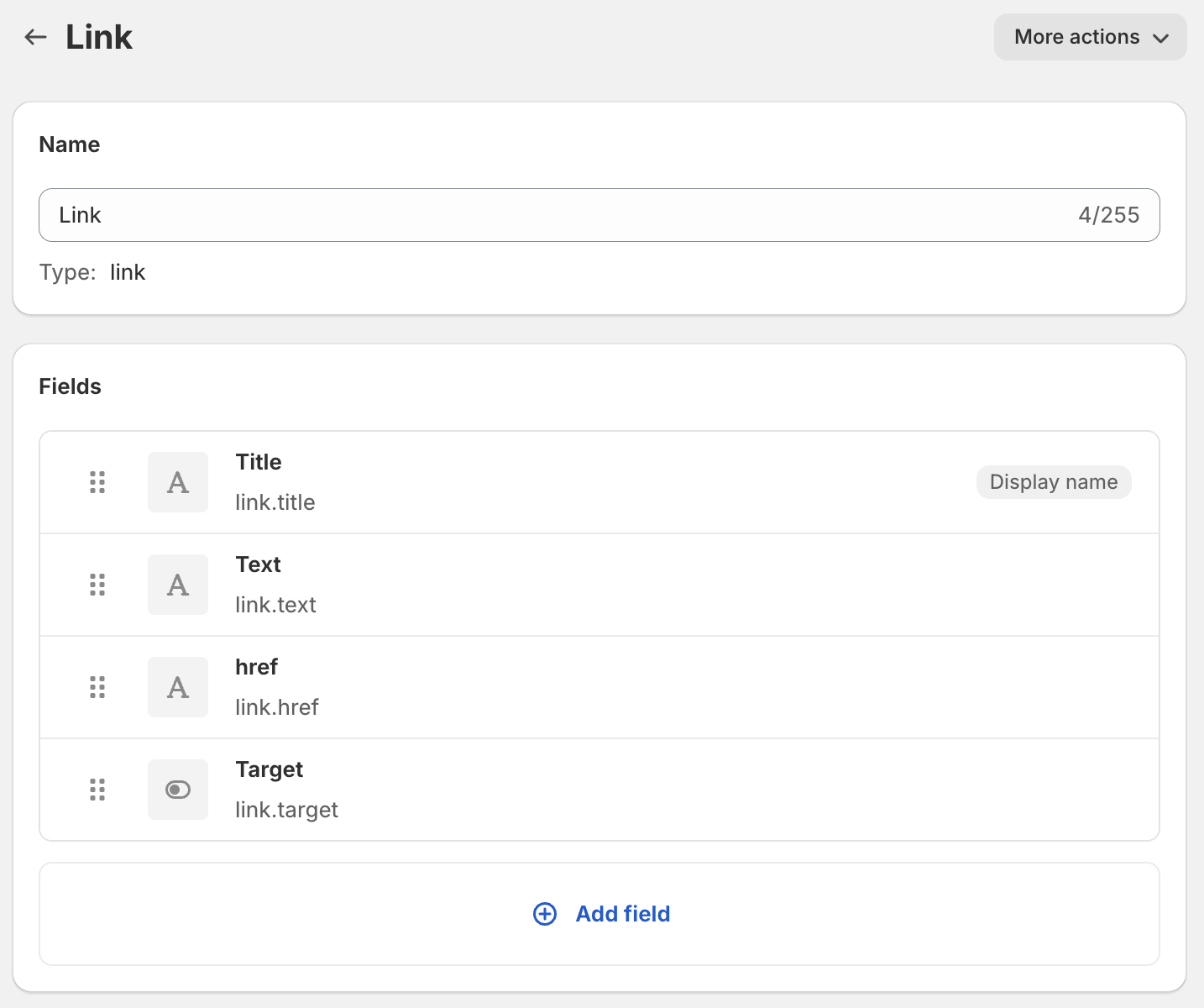
templates/skeleton/guides/metaobjects/images/definition_link.png

A screenshot of a "Featured Collections" section metaobject definition.

templates/skeleton/guides/metaobjects/images/definition_section_featured_collections.png

A screenshot of a "Featured Products" section metaobject definition.
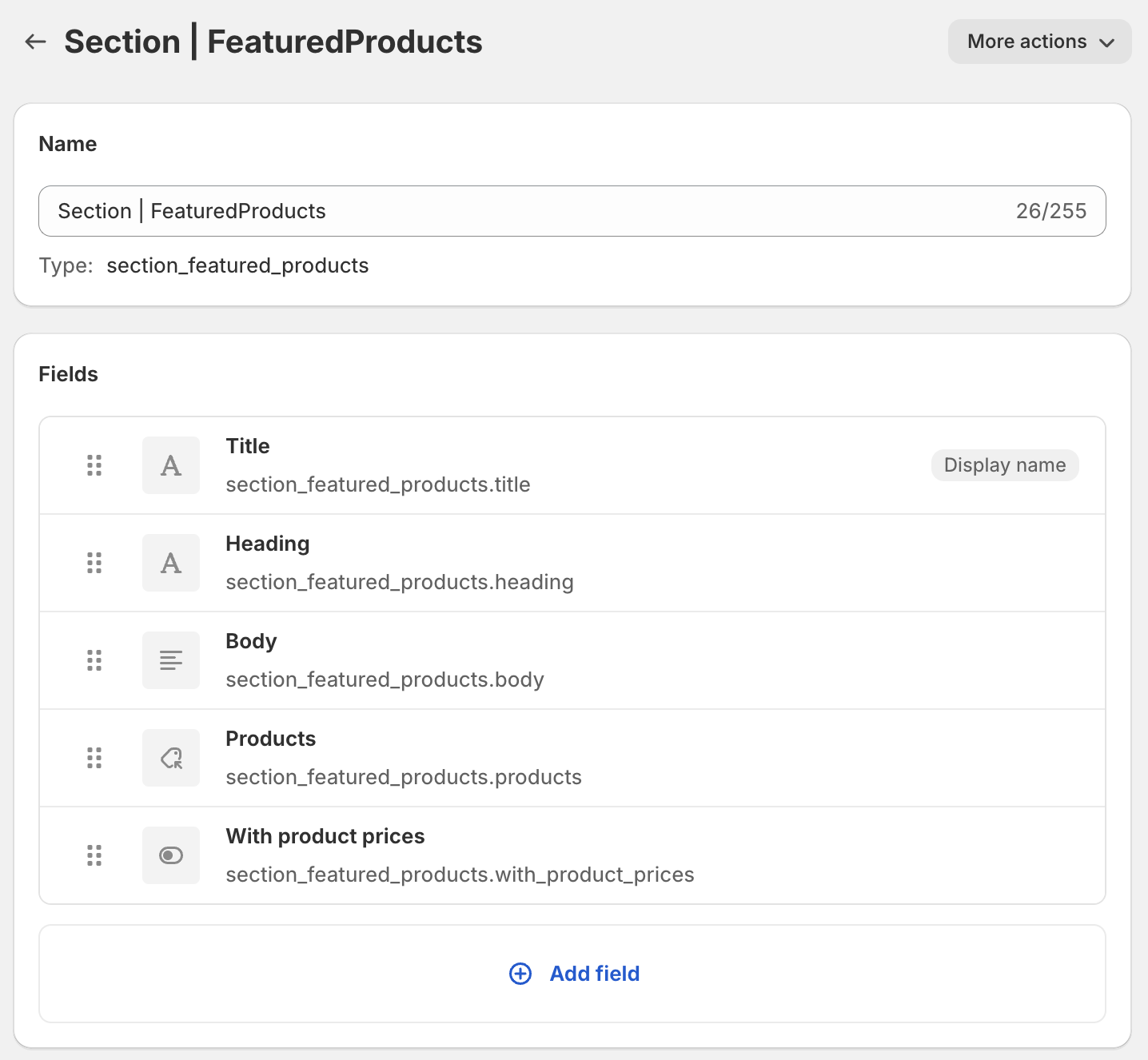
templates/skeleton/guides/metaobjects/images/definition_section_featured_products.png

Anchor to Step 21: Hero section definition screenshotStep 21: Hero section definition screenshot

A screenshot of a Hero section metaobject definition with image and text fields.
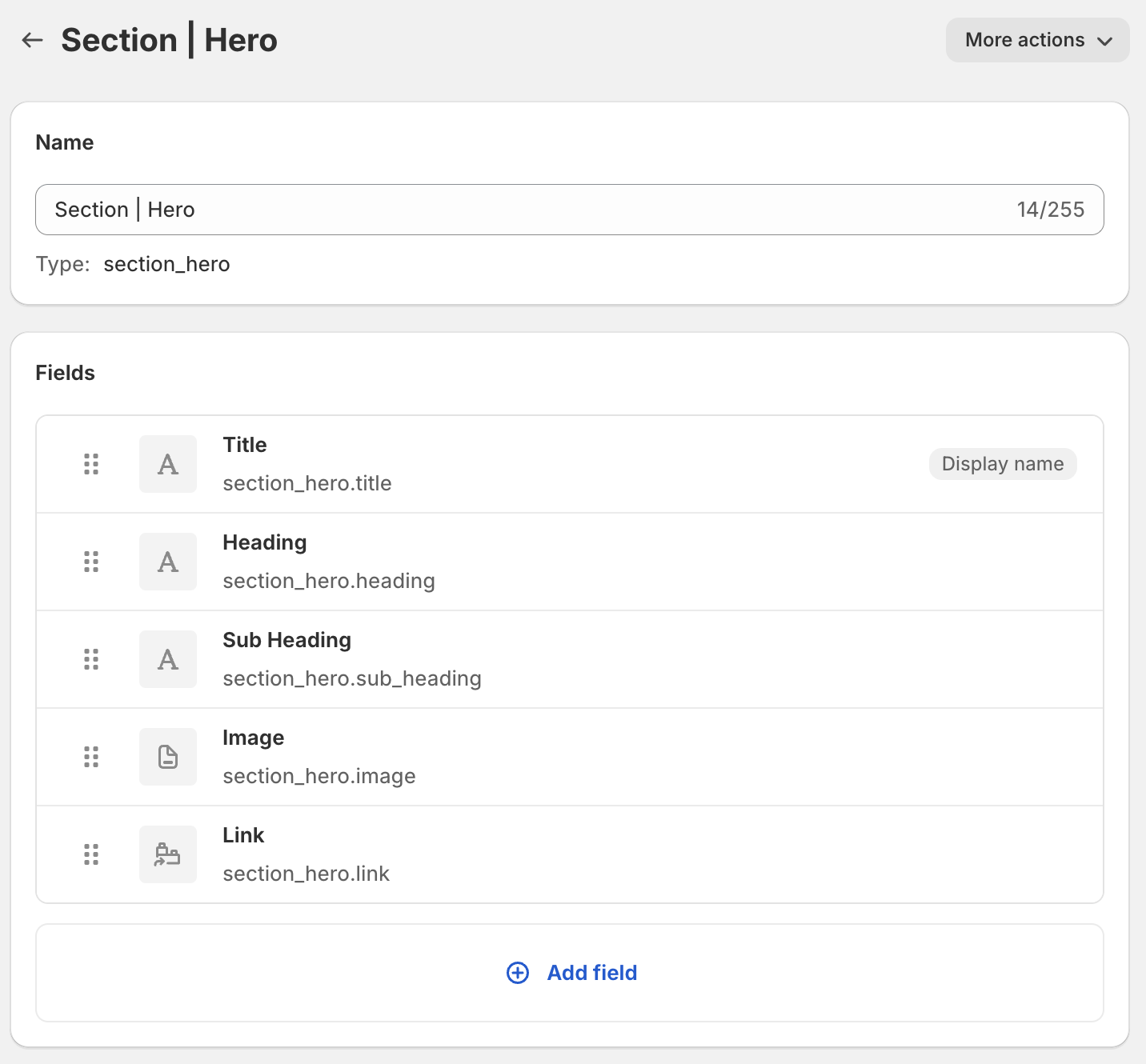
templates/skeleton/guides/metaobjects/images/definition_section_hero.png

Anchor to Step 22: Rich text section definition screenshotStep 22: Rich text section definition screenshot

A screenshot of a "Richtext" section metaobject definition.
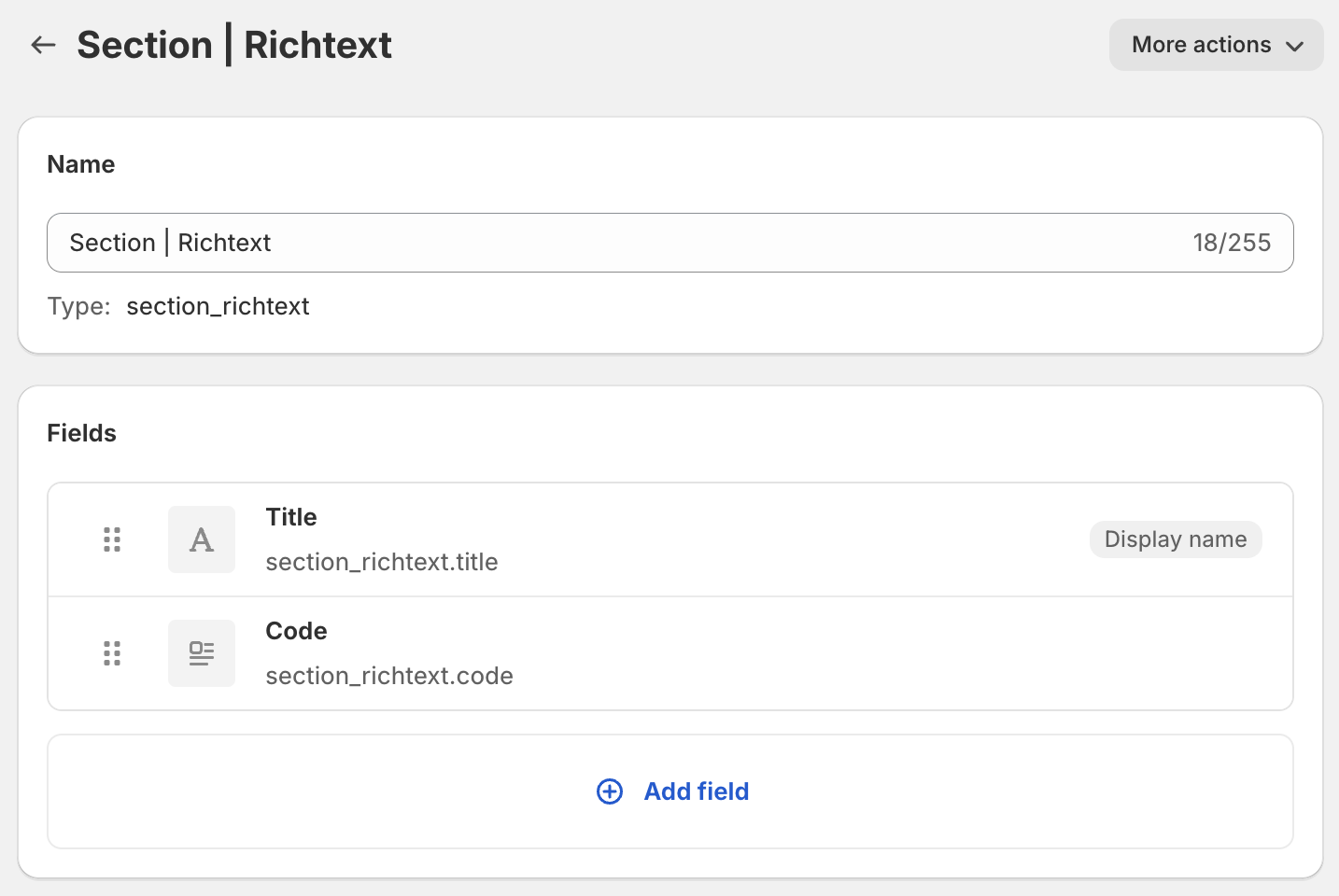
templates/skeleton/guides/metaobjects/images/definition_section_rich_text.png

Anchor to Step 23: Store profile definition screenshotStep 23: Store profile definition screenshot

A screenshot of a "Store Profile" section metaobject definition.

templates/skeleton/guides/metaobjects/images/definition_section_store_profile.png

Anchor to Step 24: Stores grid definition screenshotStep 24: Stores grid definition screenshot

A screenshot of a "Stores Grid" section metaobject definition.
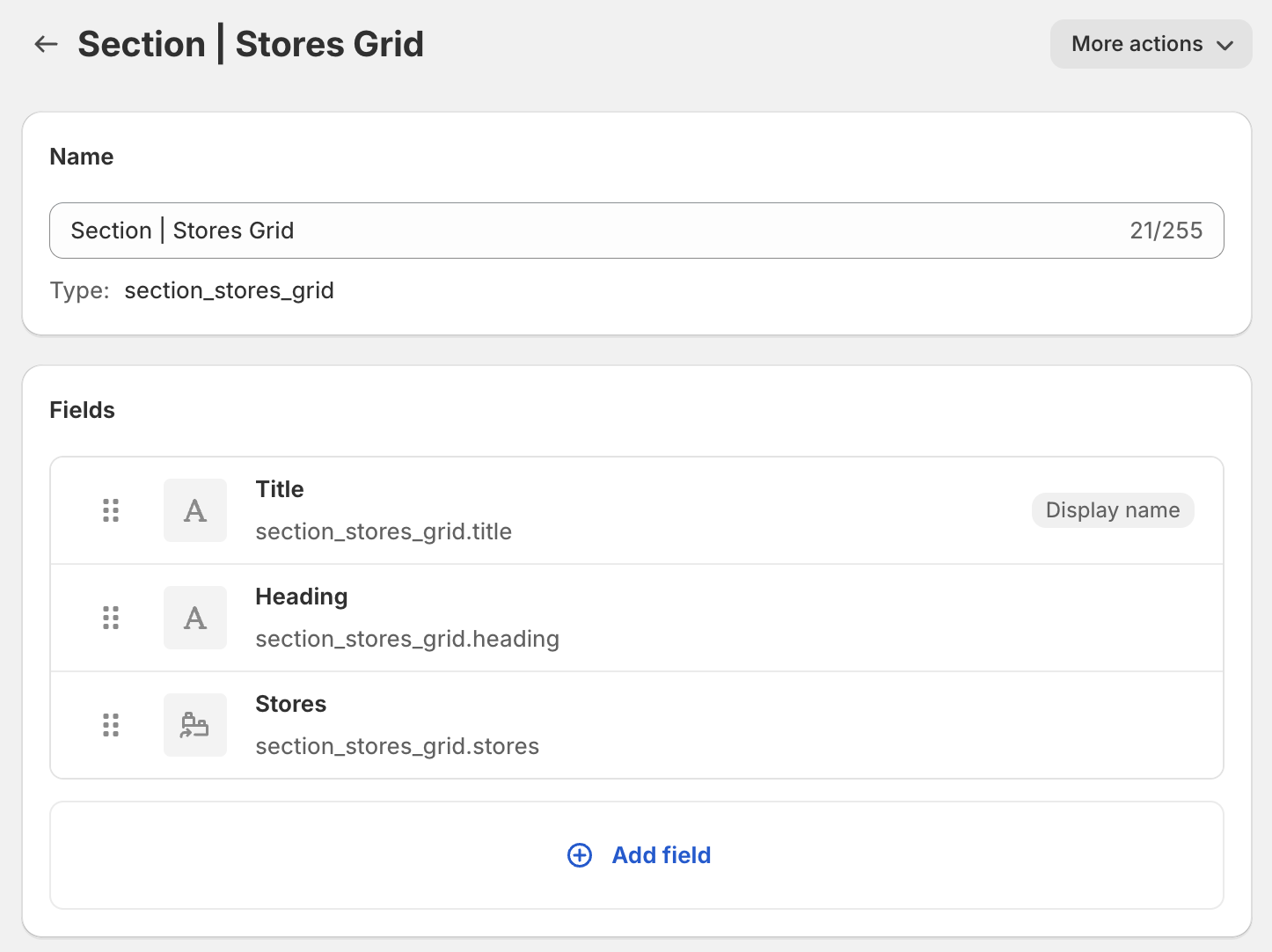
templates/skeleton/guides/metaobjects/images/definition_section_stores_grid.png

Anchor to Step 25: Store definition screenshotStep 25: Store definition screenshot

A screenshot of a "Store" metaobject definition with location and contact fields.
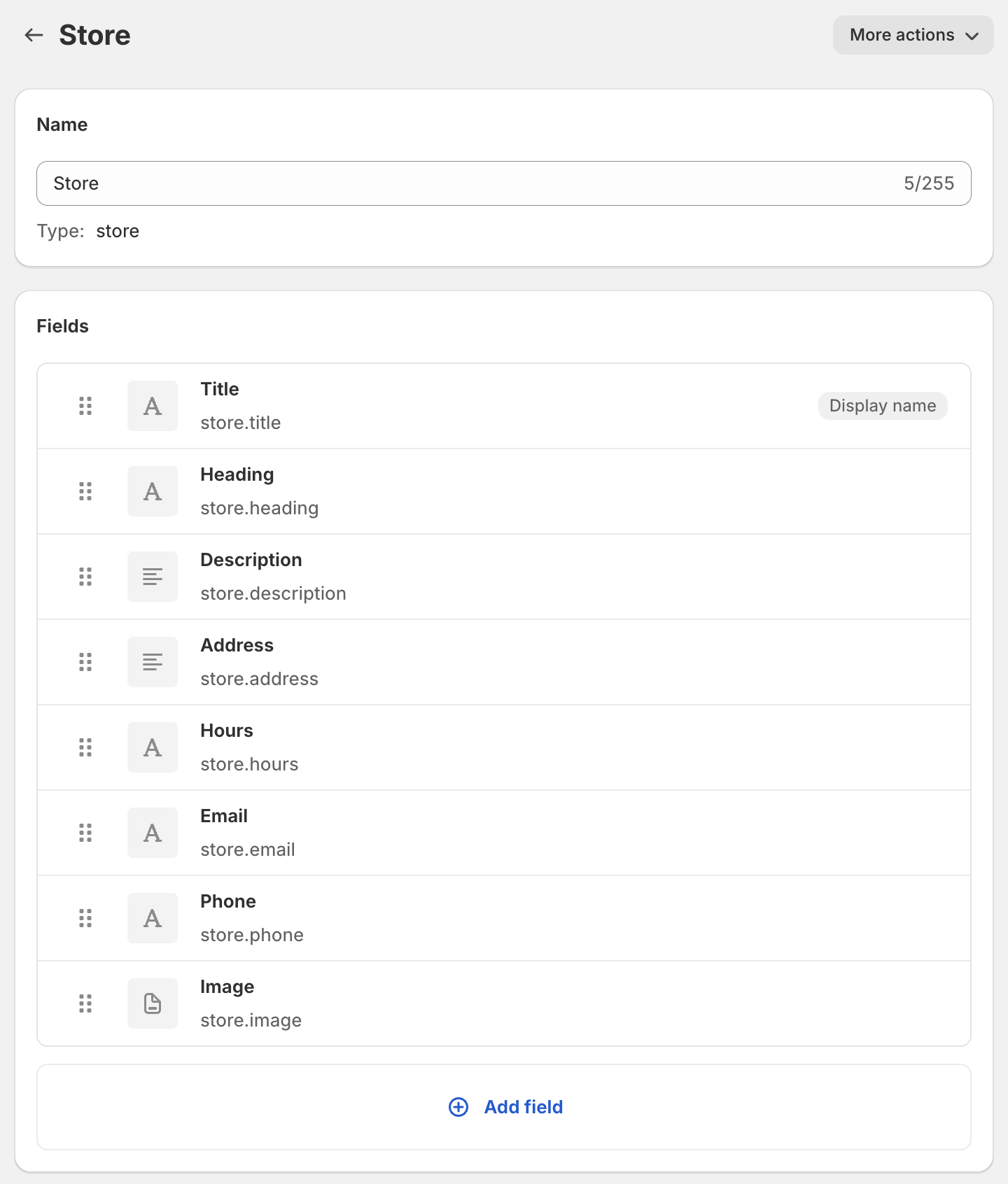
templates/skeleton/guides/metaobjects/images/definition_store.png

Anchor to Step 26: Definitions list screenshotStep 26: Definitions list screenshot

A screenshot showing a list of all metaobject definitions in the Shopify admin.
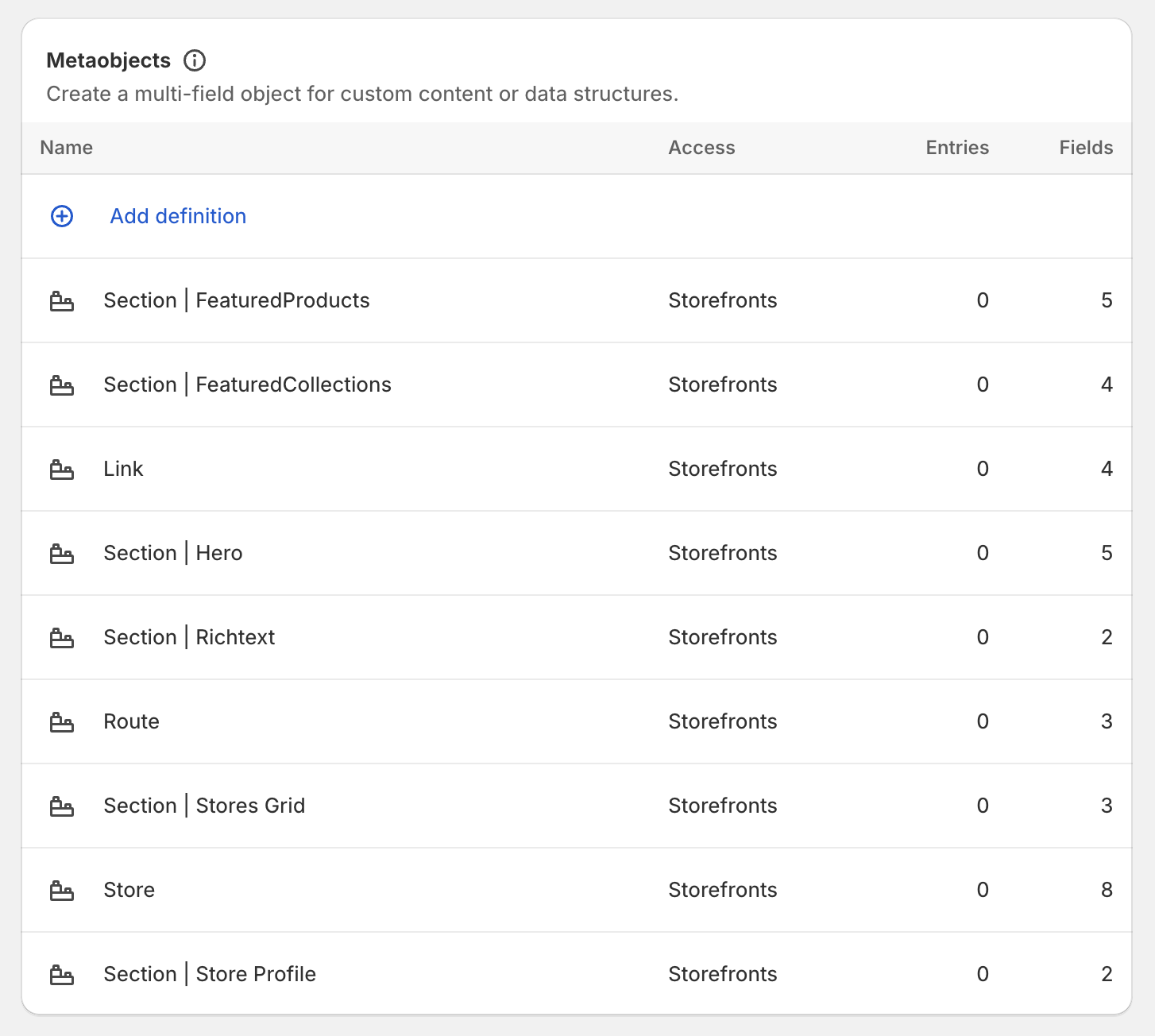
templates/skeleton/guides/metaobjects/images/definitions_list.png

Anchor to Step 27: Route definition screenshotStep 27: Route definition screenshot

A screenshot of a "Route" metaobject definition with a "Sections" reference field.
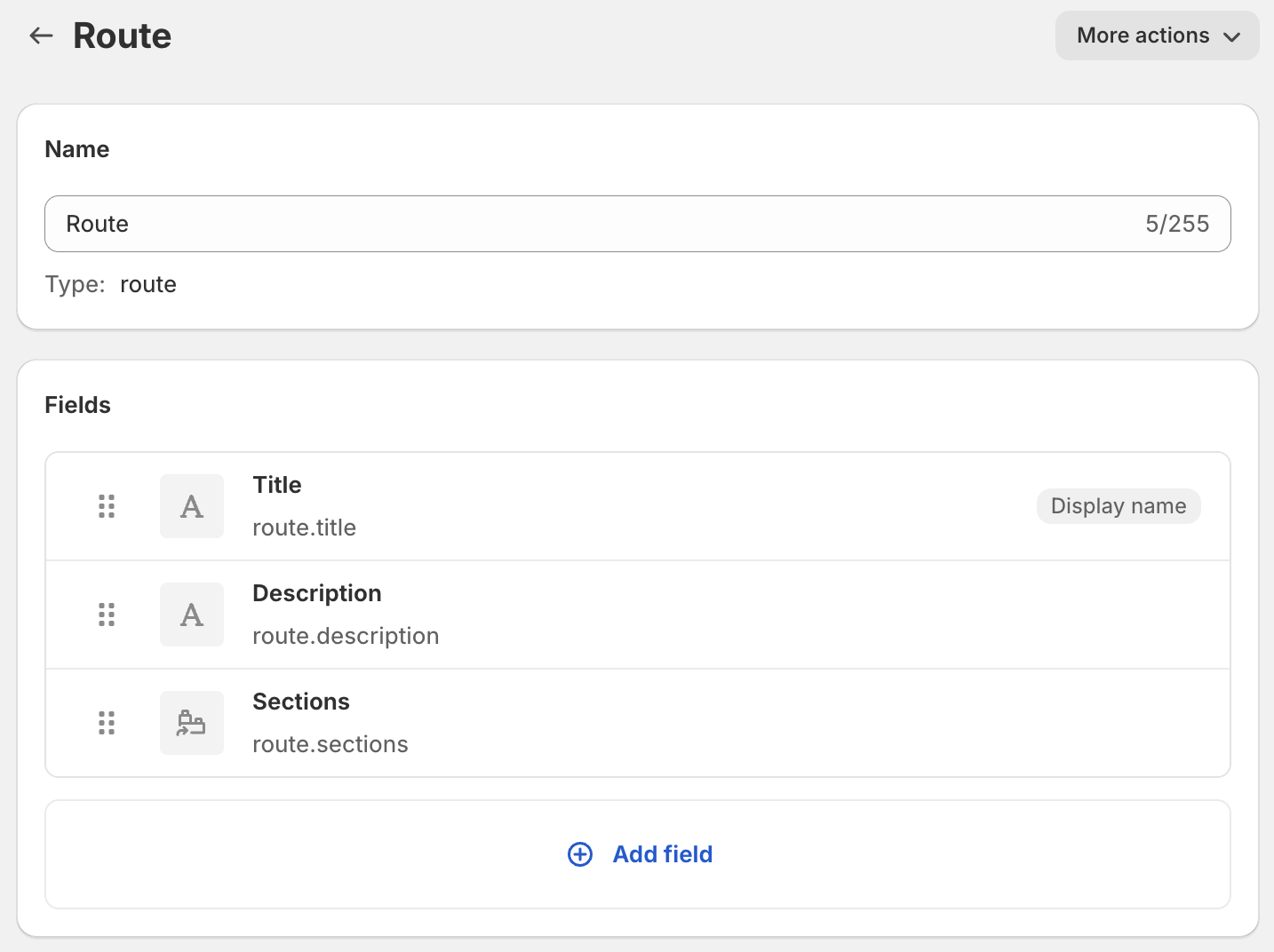
templates/skeleton/guides/metaobjects/images/definiton_route.png

Was this page helpful?